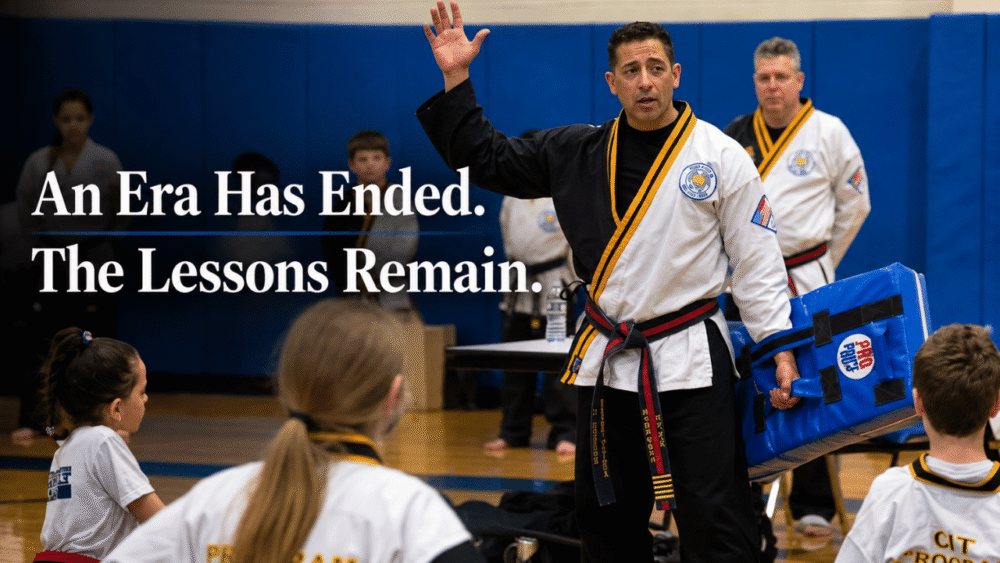
For almost three decades, one place in Mount Laurel was a major part of my life. It was where I taught and trained, where I watched children grow into adults, where families trusted me with their children, and where students became black belts, instructors, parents and, in many cases, lifelong friends. My own children grew up there too. For many years, that place was Dinoto Karate Center. Later, it became Action Karate Mount Laurel.
On September 4, 2026, my employment there ended. I did not retire. I did not resign. I did not decide to walk away. I wanted to stay.
I think that distinction matters, especially now that students and families have begun asking why I am no longer there. For more than a month, I have been thinking about what, if anything, I wanted to say publicly. I didn’t want to write from the first moments of hurt or anger. I wanted time to think, pray and process what happened. I am writing now because this is part of my history, and I believe history deserves the chance to be told—not to convince anyone to take sides or to assign motives to other people, but to tell what happened, what the experience has meant to me, and what I am learning as I move into the next part of my life.
September 4
The conversation took place over Zoom with Colan Magill, Michael St John, Jacqueline Razzi and me. Colan told me, “I’ve made the decision that we need to end your employment relationship with the school.” He explained that what the school needed from my role moving forward and the role I wanted to have were “no longer in alignment.” He then said something that has stayed with me: “I don’t think that continuing the employment relationship is healthy for you, me or the team that we’re trying to build.”
I listened. Almost immediately, I understood that I was not participating in a conversation about whether my employment would continue. The decision had been made. I could not control that decision. I could control how I responded to it.
That distinction matters to me because I have spent decades teaching martial arts, self-defense, communication, non-escalation and de-escalation. I teach people to pay attention not only to words, but also to posture, facial expression, movement, hands, eyes and tonality. Communication involves the whole human being. I was paying attention to all of those things during the meeting, and I was also paying attention to myself.
Because we were on Zoom, I could see my own image on the screen. I watched my breathing, checked my shoulders and posture, became aware of the tension in my face and hands, and made sure I wasn’t fidgeting. I listened, nodded when appropriate and kept bringing myself back to the moment. Everything I had taught, everything I had learned, everything I had practiced over the decades came into that moment.
This was my A-Game: Awareness, Assessment, Appropriate Action. Not perfect action. Appropriate action.
That distinction was already part of my philosophy before September 4. Appropriate action means making the best choice I can with the understanding I have in a particular moment. If I later discover something I didn’t know, I reassess, learn and choose again. On September 4, my assessment was that the appropriate action was to listen.
A Word That Stayed With Me
Of everything said during that meeting, one word has continued to make me think: healthy. Before September 4, I had never told Colan that working at the school was unhealthy for me or harming my well-being. Nor had he previously told me that my continued employment was unhealthy for him or for the team. So I noticed the language.
I understood that Colan, as a leader of the school, could make decisions about what he believed the organization needed. What caused me to reflect more deeply was hearing another person include me in a determination about what was healthy for me. I did not challenge the statement during the meeting because I had already determined that questioning or debating the decision would not improve the situation. Later, however, I found myself asking a simple question: On what grounds does another person determine what is healthy for me?
Perhaps that word carries particular weight because of my own history. There was a time when I was a kid in the streets making choices that hurt other people. I stole. I fought. I made decisions I am not proud of. Somewhere around twelve or thirteen years old, I began recognizing that what I was doing wasn’t making anything better. The circumstances surrounding me were real. The pain was real. The anger was real. Yet my choices were becoming mine. That realization became part of a lifelong process of taking responsibility for the human being I was becoming.
At 65, I see myself as an asset to my family and my community. That doesn’t mean I believe I have everything figured out. I am still learning. I still make mistakes. I am still becoming. Perhaps that is why being seen, heard, appreciated and valued has become so important to the work I call Living Strong. I know what it feels like to struggle for those things.
The Future I Thought I Was Building
I wanted to remain at Action Karate Mount Laurel, although I did not expect my role to remain the same forever. When Dinoto Karate Center transitioned into Action Karate, I understood that change was inevitable. I believed in succession. I believed younger leaders needed opportunities to lead, and I supported Colan becoming the Head Instructor. I wanted him to succeed. I also believed there was a place for experience alongside emerging leadership.
After decades of teaching and studying Tang Soo Do Moo Duk Kwan, I increasingly imagined my future as a senior martial artist: supporting the next generation, working with advanced students and instructors, and helping preserve the history and technical integrity of what had been passed to us. I believed generations could work together without either generation needing to become the other. Experience does not automatically make me right. Youth does not automatically make someone else wrong. Each generation has something to contribute and something to learn.
This mattered to me because the school was never simply a workplace. Mount Laurel is my home. My children grew up here. My family has deep roots here. I wanted to continue contributing to the martial arts experience of this community for as long as I had something useful to offer. I expected evolution. September 4 told me that my part in that particular organization had come to an end.
That forced me to think more deeply about the relationship between an organization, the people within it, and the art itself. Organizations need structure. They need leadership, policies, systems and revenue. People need to be paid, bills need to be paid, and decisions have to be made if an organization is going to survive. The question I have found myself considering is what all of that ultimately serves. For me, the answer has to come back to the human being.
And that brings me back to martial arts.
The Heart of the Art
I have spent more than five decades practicing martial arts. I love the physical art: Hyung, kicking, training, weapons, breaking, competition, rank and discipline. Those things have played meaningful roles throughout my life. Yet they are not, by themselves, why I am still practicing at 65. What I want to preserve and carry forward is the heart of the art of Tang Soo Do Moo Duk Kwan.
For me, that heart is ultimately about the development of the human being: character, virtue, responsibility and becoming. While writing my book, before I knew what would happen on September 4, I found myself asking a question that has become increasingly important to me: What kind of human being is all this training helping me become?
A Hyung can test memory, technique, balance and discipline. Sparring can test timing and composure. Rank can represent years of study. Life gives us different tests. How do I treat another human being when we disagree? How do I respond when I’m wrong? What do I do when I’m afraid or angry? Who am I when something important to me ends in a way I did not choose? That’s where martial virtue becomes something more than an idea. September 4 became one of those tests for me.
Fortunately, the questions I needed were already there. They had become part of my book and part of how I was attempting to live: What can I do to make this better? What can I do to not make this worse? What am I missing here?
Those questions do not make difficult emotions disappear. I was hurt, angry, resentful and frustrated. There were moments when I wanted to respond publicly from those emotions. Part of me wanted the people responsible for a decision that hurt me to understand what that hurt felt like. My training did not prevent those feelings. It gave me a way to decide what I would do with them.
That is one reason I waited before writing this. I needed time to think, pray and assess. I needed to experience what happened without allowing the most painful moments to determine what I would do next.
There is a passage in my book that means something different to me now than it did when I wrote it. I was considering the martial arts principle of always finishing what you start and realized that finishing doesn’t necessarily mean something ends the way we planned. Circumstances change. People change. Sometimes the appropriate action is continuing, sometimes changing direction, and sometimes letting go. That led me to another question:
How did I finish?
I had no idea when I wrote those words that I would soon have to answer that question in this way.
Evolution Is Not Erasure
I believe in evolution. What I do not believe in is erasure.
Dinoto Karate Center changed. Action Karate Mount Laurel emerged from that transition. Leadership changed. Systems changed. People came and went. The school will continue evolving. That is life. None of it changes what already happened. The students and families were there. The classes happened. The black belts were earned. There were conversations, struggles, celebrations and relationships. People contributed to one another’s lives. That history belongs to everyone who was part of it.
When I was a boy, I remember watching The Ten Commandments with Charlton Heston. There is a moment when Pharaoh orders Moses’ name struck from the records, as though a human being and his history could simply be erased. That image stayed with me, perhaps because I knew something about feeling invisible. As a child in the South Bronx, there were times when I felt alone and hopeless. I struggled to feel seen, heard, appreciated and valued.
At 65, I know something that nine-year-old boy didn’t yet understand: I am not invisible. My contribution happened. I touched lives, and lives touched me. I am part of this community and part of its history.
The end of my employment changed my relationship with an organization. It did not end my relationship with martial arts, Tang Soo Do Moo Duk Kwan, or the responsibility I feel to pass forward what others gave me. The organization is not the art, and the vehicle is not the journey.
That is why I do not see Living Strong as something I suddenly started because my employment ended. It is a continuation and evolution of work that has been happening throughout my life. In many ways, it began when a nine-year-old boy first stepped onto a martial arts training floor without having any idea where the journey would take him. Dinoto Karate Center became an important chapter of that journey. Action Karate became another. Now I am entering another chapter.
The Faces I Want to See
For approximately 35 years, I have carried a vision of the end of my life. If I am blessed with the opportunity to know that my final breath is approaching, I imagine myself lying on my bed and seeing faces—the faces of people whose lives I touched and the faces of people who touched mine.
That is the measure that matters to me.
I want the people I encounter to know that I see them, hear them, appreciate them and value them. That includes people who have hurt me. I also know that I have hurt people during my lifetime, and there may be people who still carry painful memories of choices I made years ago. I cannot ask others to recognize my humanity while refusing to recognize theirs.
My faith is part of this journey. I have spent my life imperfectly striving to become the man I believe God has called me to be. That work isn’t finished. Neither is my martial arts training. Neither is my story.
When I think about that nine-year-old Peter today—the boy who sometimes felt invisible, alone and uncertain whether anyone saw him—I don’t need to tell him about everything he will eventually accomplish. I don’t need to tell him about belts, stages, schools, students or books. I want to tell him something much simpler:
Thank you for waking up every day and giving it your best, even though you didn’t know what you were doing. You never, ever gave up. Thank you.
I see you. I hear you. I appreciate you. I value you. Thank you. And… I love you.
At 65, another chapter has ended and another is beginning. I don’t know exactly where it will lead, and I don’t believe I need to know yet. I remain a student, a teacher and a martial artist, with something still to learn, something still to contribute, and something still to pass forward.
When I look back across this journey, I can see that the nine-year-old boy and the 65-year-old man are still asking some of the same deeply human questions: Do I matter? Does my life have meaning? Can I be useful? Am I seen?
Maybe that is why these words have become so important to me: I see you. I hear you. I value you. I appreciate you.
They are words I want other people to know when they encounter me, and they are words I am finally learning to say to myself.
More than five decades of martial arts have taught me many things, yet beneath the Hyung, the kicks, the belts, the rank and all the years of training, I keep coming back to the human being.
To see one another. To hear one another. To value one another. To appreciate one another. And to help one another know that our lives have meaning and that we have something useful to give.
At nine years old, I didn’t have words for any of this. At 65, I do.
I see you. I hear you. I value you. I appreciate you.
And for me, that is the heart of the art.
If this story speaks to something in your own journey, I invite you to continue with me in my book, Living Strong Through Martial Arts: A Lifetime Journey of Martial Virtue.
This book is not only for martial artists. It is about what the principles and virtues of martial arts can teach us about being human—especially as we grow older, face change, move through difficult seasons, and continue becoming.